“The truth, even though I cannot feel it right now, is that I am achosenchild of God, precious in God’s eyes . . . we must dare to opt consciously for our chosenness and not allow our emotions, feelings, or passions to seduce us into self-rejection.”
– Henri Nouwen
I had a really good friend in 8th grade. She was an amazing artist and straight A student. Shehad parents and a family that loved her. She was extremely well liked at school, and was kind and friendly to all who knew her. Every earthly indicator pointed to a bright future. But she was in deep pain. So much so, one night she ingested an entire bottle of pills. She thought she could just fall asleep and not wake up, forever free from the hurt she was feeling.
But a few hours later . . . just a few hours . . . she did wake up. And she didn’t want to die anymore. She went into her brother’s bedroom, scared and asking for help. He immediately woke up their parents. They rushed her to the hospital, but the medication had already been absorbed into her organs.
There was nothing they could do, except wait for her to die.
What has always stayed with me is the realization that in just a few hours, she went from considering her life not worth living out of desperation, to desperately wanting to live.
Her feelings had betrayed her.
A little time . . . a little sleep . . . shifted her perspective and allowed her to see the hurt she was feeling was nothing worth dying for.
I am not going to pretend that for one second that I understand depression, or dismiss the very real pain that people who feel suicidal experience. Not every hurt will go away by tomorrow morning. Some hurts last months and even years.
But my hope and prayer for each and every person that finds themselves in a moment of thinking they want to choose to go . . . is that they would choose instead to stay.
Tell those who love you. Ask for help. Things we are going through, no matter how difficult, are just that . . . things we go “through“. There is a beginning and there will be an end, but the end should not be one’s life. Yes, we will all enter into hard times, but we must hold on with the knowledge that at some point we will also exit out.
It may feel too heavy to survive, but we cannot always trust our feelings. Instead, we must cling to what we know rather than what we feel. Hold on to those who love you. And when you can’t find the truth within yourself, let those who love you remind you who you really are, how much you are loved, and are valued, and what your life is really worth.
My heart breaks for every parent, sibling, family member and friend that has ever had to walk this road full of shock and pain, left longing for even one more moment with a loved one.
Don’t go. Stay.
“The Lord is close to the brokenhearted and saves those who are crushed in spirit.” – Psalm 34:18
“The best way to find out what we really need is to get rid of what we don’t.”
Marie Kondo
I have always enjoyed organizing. I love creating systems for things that make life simpler and bring common sense solutions to everyday living. I joke (but know that I am so serious) that one of my favorite places to go is the dump. I’ve been so enough times that they know me there! In my opinion, there is nothing more freeing than throwing all that is meaningless and without value away, once and for all. Off you go, into the abyss that is a ginormous dumpster.
That is until you ask me to get rid of something sentimental. Things I’ve attached meaning and value to.
I turn 50 this year, and one of the things I have come to realize is that having lots of stuff is entirely overrated. We spend the first half of our lives growing our families and acquiring all of the things we need, or think we need, to do that. And then we spend the second half of our lives downsizing and trying to get rid of it all!
When my husband and I were newly married, we “decided” it would be fun to have 3 babies in 4 years. Besides getting married, our children were the best decisions we ever made. Any parent will tell you that if you try and wait until you are financially prepared to have children, you never will. So, we didn’t wait! And we were not financially prepared!
But, with a lot of support we figured it out, just like everybody else. We also figured out that three kids sure can accumulate a lot of stuff. It wasn’t long before we decided that our days consisted of too much “picking up and putting away”. We also started to notice a pattern. There seemed to be a direct correlation between more toys and more fighting, more chaos, more discontent.
So . . . we decided they had to go. The toys, not the kids.
We tried a couple different processes to make that happen. Some with great success and others, not so much. One, which I’m sure many of you already implement, was choosing a limited number of toys to have available. We would store the rest in a big bin in the garage and reintroduce them into the mix every so often. It was like Christmas each time they got to play with a toy they hadn’t seen in a while.
For me, stuffed animals were what always pushed me over the edge in the toy department. The dust, the germs, the space they took up. All of it. There was no way we could continue to house them all. But if you think a 5, 4, and 3 year old are just going to sit quietly and let you take their “friends” away, well then you are as sadly mistaken as I was.
At first, I tried dissuading them from any meaning they thought they had attached to the whole pile of misfits. “You guys don’t even play with any of these animals. They’ve been at the bottom of your toy bin for a very long time.”
Needless to say, they were unmoved. Have you even been stared down by a toddler? Do not, under any circumstances, look them directly in the eye. If you do, you have already lost. They finally broke their silent gaze that unanimously and unapologetically said, “And? Your point?”, as if they had discussed it ahead of time. They went back to playing as if I hadn’t said anything at all. Ignoring me was their way of letting me know they would not be made to feel guilty or neglectful without their own consent.
Next, I foolishly thought that I could challenge them in the form of a game. If they could tell me who gave them each stuffed animal, they could keep it. I thought for sure I had them. I mean how could they justify keeping something when they didn’t even know where it came from?
The older two were smug, and not at all sorry about it, as they rambled off names and occasions on which they had received each and every item. I was even outwitted by the 3 year old, clearly gifted with both name association and the memory of an elephant.
When the game ended, we were keeping just as many animals as we had started with.
Unbelievable.
I had no one to blame but myself. Living 3,000 miles away from my entire family, I had a tendency to place extraordinary (unreasonable) value on anything tangible they sent our way. It didn’t matter if it was a handwritten note, a pair of socks, or a piece of jewelry. I made a big deal out of all of it. Everything was extra special because of who it came from.
Those “things” were special because they were representative of relationships. They could be present with us when family couldn’t be.
I suddenly understood part of why they were having such a hard time getting rid of the toys. Some of it was because they were little, and when you’re little everything is “mine”. But another big reason became apparent when I realized their resistance to letting anything go was because of the precedent I had set. I had unintentionally placed value on mere things, but that in actuality can only be realized in relationships.
It was an “aha” moment for me. The answer behind the “why” question.
Missing my family caused me to hold on so tightly to anything that made me feel close to them. And I wanted so badly for my children to grasp how important these relationships were, not just to me, but to them as well. Family is our first community. I wanted them to learn from a very young age that there were so many people that loved them, whether we saw they every day or not. I wanted them to know they were part of something so much bigger than themselves.
That would have been a big ask of anyone in the 3-5 year age bracket. This wasn’t their problem, it was mine. I knew it was important to teach them to keep “stuff” in its proper place in life. But the reality was it was never about the stuff. The real issue was the misconception behind what the stuff represented.
I realized I was afraid I was getting rid of memories when I was getting rid of things.
Of course, that wasn’t true. There had to be a way to hold on to the feeling an item represented and simultaneously be okay with not needing to keep it forever. To not fear losing the gift while remembering the thoughtfulness of the giver. We needed to figure out a way to not to be prisoners of our things.
We needed to learn how to let go.
After giving it some thought, I realized that anytime I found out someone needed something I had, giving it away was easy. I wanted to tap into that idea and pass it on to my kids. The idea that many times our resources can meet someone else’s need. I knew there had to be a way to help them “grieve” their stuffed animals while realizing the joy that comes in giving things to others.
So, I suggested we make a memory album. I would let them decide which stuffed animals they were willing to part with and take a photo of each one prior to it being placed in the donation pile. This made sense to their hearts. They immediately started making choices. Every once in a while, they would linger while holding a certain animal and you could see a visible, internal struggle of wanting to hold on a little longer. But more often than not, they would place the animal in the give away pile.
That’s all it took. Finding a way to preserve the memory of someone they loved. Having something they could hold onto that proved they had existed. That they were a part of their lives, even if they no longer were physically with us. And it was enough.
Just like that, a 4’ x 4’ pile was reduced to the size of a 4” x 6” photo album. They knew that anytime they missed one or several of the special friends, they could glance through the album and remember. But you know what? They didn’t. They found so much joy in the “letting go” once their focus was on all the kids that were going to be the new owners of their old friends. They didn’t bring them up again.
The joy was enough.
There is nothing wrong with holding on to items that have sentimental significance. But when deciding what to keep, we need to remember that the value of our relationships is not tied to items exchanged in those relationships. Instead, the real value is the love exchanged between those we are in relationship with. We need to “let go” of the idea that we are somehow letting go of people, by letting go of things those people gave us.
That idea may sound crazy to some of you, but many of you will know exactly what I’m talking about. Professional organizers will tell you that getting people to part with things that are attached to their memories are the hardest.
Taking photos of things is a way I have continued to be able to say “good-bye” to items while preserving those items in a tangible, yet much smaller space. Instead of multiple boxes in the garage full of school projects, greeting cards, and knick-knacks that have been passed down or given to me throughout the years, I have beautiful photos (with inscriptions on the back) to remember them by instead.
What do you need to let go of today? What do you have that somebody else might need? You can hold onto memories while simultaneously letting go of things. Our homes may be lacking space, but our hearts and minds have unlimited storage.
That’s where the joy is. And it’s more than enough.
Matthew 6:19-20 19 “Don’t store up treasures here on earth, where moths eat them and rust destroys them, and where thieves break in and steal. 20 Store your treasures in heaven, where moths and rust cannot destroy, and thieves do not break in and steal. 21 Wherever your treasure is, there the desires of your heart will also be.
“Goodness is stronger than evil. Love is stronger than hate. Light is stronger that darkness. Life is stronger than death. Victory is ours through Him who loved us.”
– Desmond Tutu
I recently flew to meet my husband in New York City for an impromptu 48 hours away together. It gave us a chance to reconnect in between two very long business trips. NYC is where we met and fell in love over 25 years ago. It’s a special city for us, as it is for so many that visit or call it home. Living on the opposite coast, we don’t get many opportunities to return to where our story began, so we attempted to fit in as many things as we possibly could during our stay.
It was early December. We walked the streets hand in hand, braving the cold and rain, taking in all the lights and sights of Christmas. We recreated our first date, dining at Ruth’s Chris steakhouse. The massive Christmas tree in Rockefeller Center was in all its glory and did not disappoint.
One of the highlights of our trip had to be our late-night carriage ride through Central Park. A bonus to doing so was impressing our twenty something’s back home with photo proof of not just the famous “Friends” fountain, but also the bridge where the infamous snowball fight scene from “Elf” took place. Because if there’s no photo, it didn’t happen . . . right??!
Not a bad itinerary for a Jersey girl, who grew up just 90 miles from NYC, and had never experienced any of those things! But perhaps our most significant stop was in front of the building where we first met. We were both working for the same shoe company in the fashion industry at the time. The company no longer exists, and the building that once housed our offices and showroom was surrounded by scaffolding, preparing itself for its next tenant.
You can always breathe new purpose into an old space, but you can never erase its history. There will always be something so significant about the vessel that once housed our beginning. Each time we are able to make it back, we make sure to get our photo in front of the Crown Building. Rumor has it, 22 luxury apartments are being prepared for some lucky (and wealthy) folks to reside in during the next season of the building’s continuing legacy.
But as for me . . . 730 Fifth Avenue will always represent a real-life Cinderella story, shoes and all, where this girl found the love of her life.
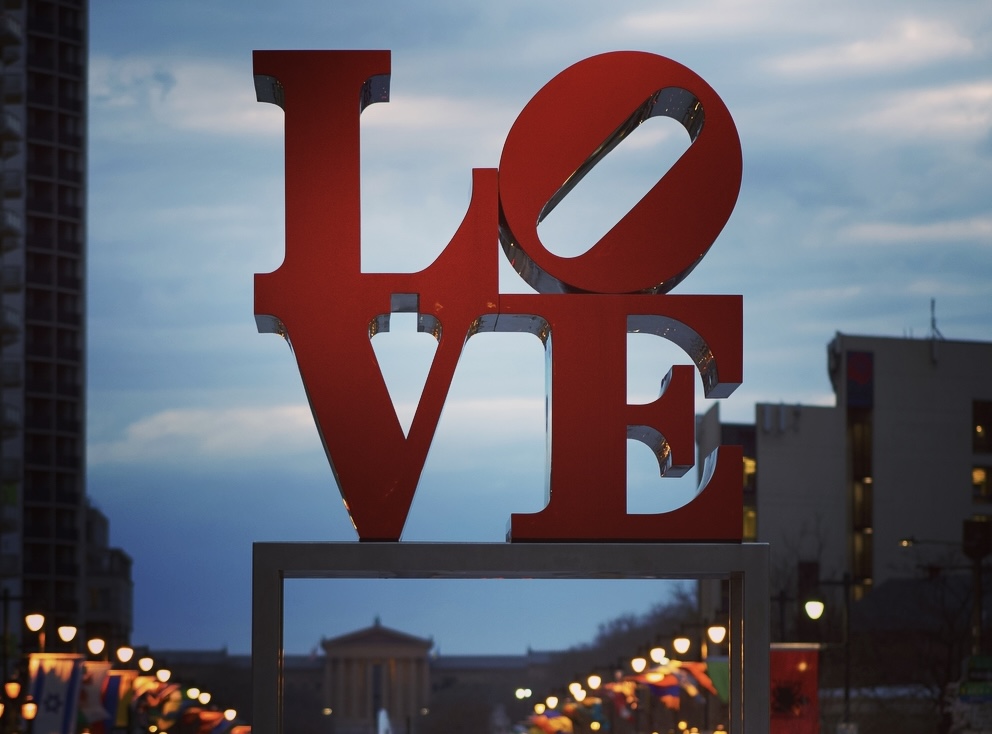
There was, however, one thing we noticed missing during our sightseeing adventures. The iconic “LOVE” sculpture. Until it disappeared , so many people were visiting the landmark on a daily basis that it made it challenging for the locals to get past the crowds. Getting a commemorative photo at the sculpture has been a fan favorite since its creation in 1970 by artist Robert Indiana. So much so that he went on to create 50 variations of “LOVE” all over the world.
But that’s what love does. It multiplies and draws people unto itself.
So, naturally when “LOVE” went missing, it’s not surprising that everyone noticed. It didn’t matter if you were a life-long New Yorker or just in for the weekend like we were. We were expecting to see it. We had come to count on its presence.
But “LOVE” was nowhere to be found.
The “LOVE” sculpture was inspired by Robert Indiana’s childhood faith. Before it was ever a sculpture, however, his original vision was part of a series of paintings. From that collection he created his first “LOVE” in the form of a personal Christmas card in 1964. Just a year later, he was commissioned to create a similar Christmas card for the Museum of Modern Art (MoMA). The rest is history.
We came to find out, after a quick search online, that the sculpture was not gone forever. It was simply on hiatus for some much-needed cleaning and minor repairs. I couldn’t help but think about how the missing sculpture symbolically represents what seems to be missing in our country today.
Many of us have been left wondering where love has gone.
It’s a legitimate question, considering the way we’ve been treating one another these days. We have picked up some really bad habits, and like any addiction, one of the biggest barriers to healing is denying we even have a problem. We find it much easier to blame others for everything that is wrong in the world. Like the sculpture, our nation is in need of repair. We, too, could use some cleaning up.
Many of us entered into 2020 with a lot of fear and trepidation. We are one nation that is currently divided on so many important issues. Adding to our angst is the fact that we are in an election year. A lot of us are standing around, shell-shocked and surveying the damage that we have already inflicted on one another. It can be paralyzing to think that it’s only January, which potentially gives us a solid 10 months to continue berating one another before election day.
Or we can do something different. We can choose to love.
Just as the artist of the “LOVE” sculpture created a structure inspired by his faith, God created the human race. He did so with two purposes in mind for us. To love Him and love other people. 1 John 4 tells us that God Himself is the very definition of love and that all love comes from Him.
God also used words to share His vision with us of what real love can look like when we love like He does. That vision in defined in 1 Corinthians 13, otherwise known as the “love” chapter. It has been incorporated into countless weddings throughout the years, including my own.
Being God, He knew long before we were born that we weren’t going to be able to love well without Him. Even those who deny His existence benefit from the moral code He has placed in the heart of each of us. A lot of us try and fill that void with things that just leave us broken.
There is simply no substitute for the kind of love only He can give.
He wants nothing more than to be in relationship with us. He promised in Jeremiah 29:13 that, “If you look for me wholeheartedly, you will find me.” But the choice is always ours.
While the “LOVE” sculpture is by far Indiana’s most famous piece, John 3:16 is easily the most “famous” verse in the Bible. “For God so loved the world, that He gave His only Begotten Son, that whoever believes in Him should not perish but have everlasting life.”
That verse is the culmination of God’s love for us. He knew that there wasn’t any way for us to reconcile our relationship with Him. We were without hope and unable to save ourselves. He couldn’t imagine being without us and knew we needed rescuing. So, He sent us his Son, God in the flesh. He sent us Jesus.
He wanted us to know that hope was on the way.
I find it thoughtful, and simultaneously ironic, that what was chosen to stand in as a temporary replacement for “LOVE” is a statue titled, “Listen“. A local artist, Jim Rennert, created the sculpture in the hopes that people passing by would pause and reflect. The sculpture is of a man, looming life size, holding his index finger to his lips. This is the universal symbol to be quiet and I find it humorous that the bronze man is essentially “shushing” us. The artist was encouraging reflection not censorship. If we refuse to navigate our differences with civility, however, then it seems as if silence would be a pretty good posture until we’re willing to do so.
Pastor Andy Stanley has an amazing 3 part series out right now title, “Talking Points: The Perfect Blend of Politics & Religion”. It is geared toward those of us who call ourselves Christians, but is an incredible blueprint for anyone interested in loving people well regardless of their politics. One of my favorite quotes from the series is as follows:
“When we choose to carry someone’s burden . . . we listen, we learn, and we lean in. When we choose to carry someone’s burden, what divides us diminishes, and what unites us surfaces. We fear less, and we understand more.” – Pastor Andy Stanley
Imagine what would happen if we did less talking and more listening. If we used our time and energy to really get to know people that we assume are so different from us. Loving others like God does honors the humanity in each and every person without conditions. We are created in His image, and it is He who give each of us our value.
It always starts with a relationship, laying a gradual foundation of mutual respect and trust over time. It is in those relationships that we feel safe and heard . . . even when we don’t see eye to eye.
What if we learned to ask really good questions? What if we leaned in to the idea of working to understand who people are, learning firsthand how they have come to feel the way they do about important issues?
Doing so may not change our minds, but it for sure will change our hearts.
No word on when “LOVE” will be back on the corner of 55th and 6th. But unlike the missing sculpture, real love is alive and well, and can always be found by anyone truly seeking to find it. Love is so much more than a feeling. It’s always a choice we make. If we want to see things turn around in this country, we are going to have to want it. Even over wanting to be right.
Beautiful things happen when we align our will with the purposes of God. When we open ourselves up to our Creator’s way of doing things, we fulfill the unique purposes for which we were put on this earth. To see that happen, we are going to have to let Him change our hearts. We do that by saying “yes” to God and respond to His loving us by loving Him back. We don’t have to change our opinions, our beliefs, or our political parties to love others well.
But we do have to choose to love people like God does.
The same God that reconciled our relationship to Him wants to heal our relationships with one another as well. As much as we might like to blame others for the nationwide fail at agreeing to disagree, we all have to own our behavior. We cannot control others in word or deed, but we always have the option of controlling our reactions. We always have a choice in how we respond. Nothing someone else does or says will ever justify bad behavior on our part.
We need to own what we put out into the world.
The truth is our words are going to outlive us. Thanks to social media, we get and give information so quickly that the rate of words flying out of our mouths has exceeded the filter in our brains. At the end of the day, it doesn’t matter how right we think we are if our behavior is wrong. We need to open our eyes to the hypocrisy of calling things out in others that we ourselves are currently doing. We have Fundamental Attribution Error to thank for that.
An article out of the University of Texas explains it well. “Because of the fundamental attribution error, we tend to believe that others do bad things because they are bad people. We’re inclined to ignore situational factors that might have played a role.”
“So, the fundamental attribution error explains why we often judge others harshly while letting ourselves off the hook at the same time by rationalizing our own unethical behavior.” (See more on FAE below.)
The culmination of all that we were able to see and do during our time in NYC ended up being right outside our hotel. The “HOPE” sculpture, another work by the same artist, is on display just three blocks away from where “LOVE” had once been. Hope, by definition, is “the feeling that what is wanted can be had or that events will turn out for the best.” We need to make sure that what we say we want correlates with what we do.
Feelings come and go, but love is a choice.
Robert Indiana passed away in 2018, but will always be remembered for the legacy of “LOVE” and “HOPE” he left behind. The words he chose to create as art are a testament to what he wanted to put out into the world. What will we be remembered for? What will we leave behind? What are we putting out into the world?
I hope it’s love.
Learn more about the Fundamental Attribution Error in this short video from the University of Texas:
A few years back, I was on a whale watching tour with my family off the coast of the San Juan Islands. The tour was sold out, so we found ourselves in very close proximity to the other passengers. It was impossible to not overhear the multiple conversations happening around us in between our own.
One in particular has stuck with me to this day. Two men were discussing some of the similarities and differences between living in America versus Europe. The man from Europe shared an observation that he felt demonstrated a subtle, yet distinguishable difference in questions we ask when meeting someone for the first time.
He had observed that after an initial introduction, one of the first questions people in America will ask is, “What do you do?”. He said in his country of origin, the question more commonly asked is, “What do you like to do?”.
I love that! Just by adding in those two little words, the emphasis completely changes, as does the trajectory of interest. The focus shifts from asking about what we are obligated to do, and instead, inquires about things we choose to do. It directs us from an occupation to recreation. From work to play.
I don’t want to imply that one’s profession can’t be something they enjoy or feel passionate about. Many people do. One of the best pieces of advice out there is the idea that if we can find something we love to do, and earn a living doing it, we’ll never work a day in our lives. (Everyone from Mark Twain to Confucius is credited with a version of that quote, so choose your favorite and say thank you!)
What I do mean is that the first way infers action, something that a person has to do. At best, asking that question reminds us of work, which is the last thing many want to discuss when relaxing in social settings. At worst, it can allow for comparison to sneak in, leaving the potential for some to feel like their answer needs to justify their worth.
No one should ever feel or be made to feel like they don’t measure up in some way. But of course it goes on. Some may struggle with a very real sense of intimidation, particularly when in a diverse group.
People in blue collar positions may feel “less than” based on salary alone, whereas people in banking or tech related fields may seem aloof or unapproachable. We get ourselves in so much trouble by stereotyping other people based upon very limited information given to us about who they are. Sadly, many times we prejudge on appearance alone.
When we do that, we can so easily get distracted while trying to make our own best first impression. We show up as our worst selves in those moments out of insecurity. We may come off as defensive, unknowingly imply we are “greater than” in some way, or convey a complete lack of interest. All of those approaches shut down communication whether they are true or not. It can get awkward real fast and keep people from pursuing further conversation.
But the second question doesn’t allow much room for that. It cuts right through that first layer of obligatory conversation. Asking people what they like to do sends an additional underlying message of real interest in who they are. There is an authenticity to it that says that we want to know more about things they care about. It brings a sense of wonder into the conversation space and places value on what the other person is about to share, even before they do. When we combine a good question with active listening, we send the message to others that we care about what they have to say.
It sets the kind of tone between two people that makes it so much easier to open up. To be real and vulnerable.
Asking good questions attaches greater value to who the person is versus what they do. We live in a society with an unrelenting message that always requires that we do more and be more, and our value is adjusted accordingly in their eyes. How refreshing it would be to ask people instead to share with us what makes them feel alive, versus what they do to make a living.
It’s so easy to fall into the same old line of questions we routinely ask. The ones that require no real thought or energy on our parts. The ones that can be recalled instantly from muscle memory. The safe ones. I want to move past the, “How are you?” question without truly expecting or waiting for an answer. Past the knee jerk, shallow banter of, “So, what kind of work do you do?”. These questions are not bad in and of themselves.
But we can do way better than that.
We were all taught in school that there’s no such thing as a bad question. Maybe not. But I’d like to think that it would be so easy for us to infuse a little more care and effort into our daily interactions. Showing genuine interest in getting to know the people we encounter will go a long way towards building a better sense of goodwill in our social circles and communities. Even, and most importantly, in our families.
I want to learn to ask more creative questions seeking to truly connect. To move from merely trying to fill uncomfortable space between me and another person to being fully present. I want to initiate the kind of conversation that makes others feel truly seen.
One of my favorite things to do is ask married people to share their back story. It has been my experience that people love to revisit that time in their lives. To see the joy on their faces as they recall how they met and what it was that made them choose one another.
So, how about you? What is your favorite question to ask? What is the most thought provoking question you can remember being asked?
What would you consider your design style to be? If you had to choose just one, what would you say is your favorite item to decorate your home with?
I really try to only integrate things into my own home that mean something to me. Items that have a value that can always be tied to something or someone I love. I like to surround myself with reminders of special times with family or photos that mark significant moments in our journey together.
One of my favorite things to decorate with are patent prints. They are so on trend and widely used as home décor by many a designer. At the same time, they have a history and almost a soul to them, many having been around for hundreds or even thousands of years. There’s something comforting about things from so long ago being represented in our lives today. They still have relevancy.
Patent prints appeal so much to me because they reveal an item’s intended design. They illustrate an item’s unique purpose from their creator’s unbiased perspective. They show us the vision the creator had for their use in this world. Every invention has a purpose.
And every time I see a patent print, I think about what purposes God had in mind when He created you and me.
Our society disagrees on an awful lot right now. At least that’s what gets the most attention in mainstream media today. There are a lot of complex questions being asked and many important issues that need attending to if we are going to start facilitating real change in our country. But for today, let’s just solve one major household conflict once and for all.
How to properly install a roll of toilet paper.
If this has ever been an argument in your home, raise your hand. We all profess to know the “correct” way to replace the roll. As a mom, I’m just happy if someone does it at all! But between you and I, you know the flap should be on the outside. Over vs. under!
In all seriousness, I believe that to be true. The flap belongs in the front. I’m not just confident in that belief because that is my preferred method, or because it’s the example that was set before me when I was growing up. It’s because I’ve seen the patent.
I have seen for myself what the creator had in mind.
I’ve been writing in regards to what can be done to change the trajectory of how we communicate on social media. To change the way we treat and speak to one another online. Many people are wondering why the same rules that apply to social interactions in person don’t transfer to online exchanges? What is it that allows us to say things on social media that we would never say when face to face? I believe it’s largely in part because we can’t really “see” one another, literally or figuratively.
And when can’t see one another visually, it can be hard to “see” each other at all.
Social media was created as a platform for connection. To provide unlimited opportunities for users to network, sharing both ideas and information. We can meet and talk with people from other countries. We can see, learn, and even experience things from our laptops while in pajamas from home that we may never be able to in real life.
Used an intended, the world wide web provides us access to the whole wide world.
But we shouldn’t expect social media to do what it wasn’t created to do. Technology may be able to facilitate connecting, but it cannot generate true connection. Social media will never be able to replace what it means to be up close and personal with another human being. To show dignity and respect by looking in a person’s eyes while speaking with them. By listening to each other, conveying interest and validation when needed.
That’s what we were created to do.
Instead, we find ourselves blinded by our own one dimensional perspective. We have been rendered incapable of seeing ourselves as we could be. The way God sees us. We are not one, but instead multi-dimensional beings, created in His image. We forget that we have spiritual, emotional, and intellectual components to us in addition to our physical selves.
When we choose to live out our own version of how we see ourselves, we forfeit the best version of who we were actually made to be. We can no longer see God’s version or vision of us and for us. Our ability to see reality also becomes compromised, along with all the truth about ourselves that goes with it. We settle for a dim reflection of who we think we are reflected back to us in a screen.
Our behavior almost always reflects our beliefs.
When we take God out of the picture, our view of ourselves and others becomes distorted. We no longer see value or purpose when we look in the mirror or at those around us. It becomes really easy at that point to use every opportunity for self-preservation or self-promotion.
As humans, our natural born tendency is to behave in ways that are self-destructive and/or hurt other people. We don’t consider the ways we inadvertently use our words to devalue others to try and increase our own worth. Sadly, being face to face may enable us to control what comes out of our mouths simply for fear of confrontation or what others may think of us. But it can’t change what is in our hearts.
Only God can do that.
We seem to be able to use restraint when we’ve got skin in the game. We know there is a real risk of losing relationships and people we love if we don’t treat them well. When we choose to see value in another human being, we find a way to sift and carefully consider the words we use before they leave our mouths.
Because we know it will cost us something not to.
But it’s open season on anyone and everyone that we don’t value personally. We feel everyone is entitled to our opinion, and argue with anyone that feels differently. We shame and blame anyone that voices a difference of opinion for all that ails this world. We do this all while feeling zero culpability for the wounds our words inflict on people we don’t care for. We begin to think we decide who has value and who doesn’t and then act accordingly.
And that’s where we lose our way.
This is what happens when created things are not fulfilling the intended purposes of their Creator.
You may or may not be familiar with what is probably the most recognizable verse in the Bible. John 3:16. It’s the verse that has been on display everywhere from roadside billboards to signs at sporting events held up by eccentric fans.
The Message, an easier to understand version of the Bible penned by Eugene Peterson, breaks it down and includes verses 17 and 18 . . .
John 3:16-18 “This is how much God loved the world: He gave his Son, his one and only Son. And this is why: so that no one need be destroyed; by believing in him, anyone can have a whole and lasting life. God didn’t go to all the trouble of sending his Son merely to point an accusing finger, telling the world how it was. He came to help, to put the world right again. Anyone who trusts in him is acquitted; anyone who refuses to trust him has long since been under the death sentence without knowing it. And why? Because of the person’s failure to believe in the one-of-a-kind Son of God when introduced to him.“
God decided a long time ago what each and every one of us was worth to Him. He did everything in His power to make a way for us. To ensure that He would never have to live without us or not be in relationship with Him. All He asks of us in return is that we trust Him. That we believe Him and take Him at his word.
Believe what you may be asking? We make it so much harder than it needs to be. To be a believer means to simply agree with God. Trusting that what He says about Himself and about us is the truth. The very reason He created us with a free will was so that we could decide on our own if we will do just that.
Trust Him. Trust that the Creator knows what is best for His Creation.
God knew how much words matter. How powerful they can be. He Himself used them to literally speak the world into being. Throughout history, when He wanted to communicate important messages He did so using the written word. He gave us the Bible, an entire collection of books, telling us over and over again how much He loves us.
Cover to cover, the message never changes.
He reminds us that we are living in a world that is a reflection of us choosing what we want over what God wanted. He offers us a way to see it all redeemed. That one day, if we take Him on His word, we’ll get to see Heaven and Earth as it was supposed to be.
He also knew that we learn best by example. So He sent us a living and breathing version of what He had intended for all of humanity when He created us. He wanted us to know what it looks like to love unconditionally and sacrificially in a way we could best understand. So, He sent us the ultimate example in human form.
He sent us Jesus.
Take a look around our world and it won’t be long before you find the unlimited and far reaching symptoms of sin. It’s easy to look outward and see the bigger offenders in our society. Murder, domestic violence, along with drug and alcohol addiction are all obvious examples of how destructive sinful choices can be. It can be much more difficult to turn inward and focus on the ones that are easier to hide. Including the ways we sin against one another while hiding behind our computers.
The ones that go on in our own homes and more importantly, in our hearts.
All those things we say or do that we can’t take back. The selfish motives and dishonest intentions behind so many of our actions. The way we show up for strangers better in some ways than we show up for our own families. The times we so quickly excuse our own behavior away while judging others harshly. For all the lies we tell ourselves and others about why we do what we do. For all the ways we hurt those we say we love. All of it.
That’s where the real work is.
The problem is, we’re not capable of doing that work on our own. Until we align ourselves with God’s vision for us, we will never be all we were created to be. Until we ask God to show us who we really are, we will forever be at the mercy of our feelings or other people’s opinions. Every time we reject God, we are choosing less than.
Less for ourselves, and less for others.
“For now we see only a reflection as in a mirror; then we shall see face to face. Now I know in part; then I shall know fully, even as I am fully known.” – 1 Corinthians 13:12
So, how do we learn to truly see one another? How can we know what God originally intended for our unique purpose? How can we reclaim His vision for us?
Do you know what you’re worth? If so, who or what gave you your value?
In my previous post I shared what I thought was the most important thing I know walking into 2020. The idea that it doesn’t matter what else we do well, if we are not loving people well.
That can be really hard to do sometimes, especially if we are depending solely our own strength to do it. I’m thinking generally, but also specifically about how we can “love people well” on social media. Love is a strong word you say. So it is. But it’s what we are going to need if we are to change the way we relate to one another online, and in real life.
We are going to need a lot more than to simply “like” one another.
I love the idea of social media. I love learning about people and relationships, and I am all in for anything that provides healthy connection. But in many ways, social media has become an outlet for every form of abuse you can think of. We seem to have lost all sense of decorum, along with every good thing we have been taught about how to treat others.
We humans like to appear socially appropriate, so we try as hard as we can to live life inside what we think those parameters are. Our ability to do just that on social media, however, seems to go right out the window the second people disagree.
Because we also really like to be right.
The sad thing is, our capacity for both empathy and understanding is so limited when we choose to see life solely from our own perspective. There is no listening or learning going on inside our own personal echo chambers. But imagine what would happen if we could see ourselves and others through God’s eyes? What do you think He sees when He looks at us? When He looks at you? What value do you think He places on each of our lives?
We don’t have to try and imagine.
No matter where you stand today on issues of faith, almost everyone knows and believes we are all born with a moral compass. An innate understanding that there is good and bad, right and wrong in this world. I believe that God has created us with that compass so that ultimately, we can find Him.
When I find myself searching for answers in this life, my faith persuades me to look to what God has to say about things. When it comes to our value, who knows better than the Creator Himself, the worth and purpose of His creation?
Most of us have no idea how much God values and loves us.
I feel so compelled to share what God has to say about us. To speak especially to those who are made to feel like they don’t measure up. Those whose voices are shushed and discounted as irrelevant. To those who are made to feel less than in an way.
It may be something you’ve heard a million times or never even once before. But I can’t think of a more important time in history to reiterate a more important message. To repeat what God has literally been saying since the beginning of time. There are so many voices, so much noise, in our world today. It’s so critical to cut through it all and decipher what is real and good and true.
So here goes . . .
God doesn’t play favorites. He “likes” and loves each of us the same, no matter what. He also knew that we would all need rescuing from ourselves and our sin. Sin isn’t used a lot in mainstream conversation today, so it can seem like a really weird word to use. But sin is simply anything and everything we do that causes us to fall short of God’s perfect moral law. Every bad thing you can think of. Everything listed in the 10 Commandments and then some. It includes all the ways we mistreat one another, in both the real and virtual worlds.
Even if we think we only fall “short”, and that we are overall a “good” person in our own minds, the list of ways we sin on a daily basis is long. Humanity continues to come up with new ways to rebel against God and hurt one another. But all of it can be traced back to the original sin.
Not believing the truth about who God says he is.
Adam and Eve were guilty of it and so is every one of us that has been born since. They didn’t want to be told there was that one thing they couldn’t have, even when they were given access to everything else. They didn’t want to believe anything should be off-limits. They didn’t believe God when He said there would be consequences.
Ultimately, they didn’t like being told no.
And neither do we. We’re all born with the idea that if we want something, we should get it. If you don’t believe that, spend some time with a toddler. They don’t understand that as parents, when we say no, it’s not because we are trying to keep something good from them. It’s because we are trying to protect them and keep them from something that could harm them in some way.
It might be an object, a behavior, an unsafe environment or even unsafe people. But they don’t want to believe us. They want what they want, and they want it now. If they don’t get it, they pitch a fit.
And so do we.
We don’t want to believe God. We don’t want to believe that we need Him or anyone else for that matter. We think we know best. We choose to believe that we should be able to do whatever we want, without consequence. That there shouldn’t be any boundaries placed on us or on our behavior.
But of course, God knew what the results of our insisting on our own way would be. What the cost would be of allowing us to have freedom of choice. He knew that even on a good day, our best behavior wouldn’t be enough to earn our way back to Him. He knew that there was nothing we could do to help ourselves. That’s what sin does.
It hurts us and separates us from those we love.
He knew we needed a plan. He communicated that plan to us in love letter form, using the Bible. He wanted to try and convey to generation after generation just how much He cares for us. He wanted us to know that He would never abandon us or leave us in a helpless state, just as He had promised all of His children who came before us.
No parent would choose separation from their children. As our Father in Heaven, He couldn’t imagine living a day without us, let alone an eternity. He knew that unless He intervened, sin would keep us from Him forever. So that’s just what God did. He intervened.
Romans 5:8 tells us, “. . . that God demonstrates his own love for us in this: While we were still sinners, Christ died for us.” He doesn’t wait for us to try and clean ourselves up. He loves us just as we are, right where we are.
That’s what love does.
One of the most well-known passages of the Bible is 1 Corinthians 13. It’s called the love chapter for good reason, as it defines what love is from God’s point of view. It’s been read and recited during countless wedding ceremonies, and is a reminder to all of us all what real love should look like. If you aren’t familiar with the passage, here is what it has to say:
13 If I could speak all the languages of earth and of angels, but didn’t love others, I would only be a noisy gong or a clanging cymbal. 2 If I had the gift of prophecy, and if I understood all of God’s secret plans and possessed all knowledge, and if I had such faith that I could move mountains, but didn’t love others, I would be nothing. 3 If I gave everything I have to the poor and even sacrificed my body, I could boast about it;[a] but if I didn’t love others, I would have gained nothing.
4 Love is patient and kind. Love is not jealous or boastful or proud 5 or rude. It does not demand its own way. It is not irritable, and it keeps no record of being wronged. 6 It does not rejoice about injustice but rejoices whenever the truth wins out. 7 Love never gives up, never loses faith, is always hopeful, and endures through every circumstance.
8 Prophecy and speaking in unknown languages[b] and special knowledge will become useless. But love will last forever! 9 Now our knowledge is partial and incomplete, and even the gift of prophecy reveals only part of the whole picture! 10 But when the time of perfection comes, these partial things will become useless.
11 When I was a child, I spoke and thought and reasoned as a child. But when I grew up, I put away childish things. 12 Now we see things imperfectly, like puzzling reflections in a mirror, but then we will see everything with perfect clarity.[c] All that I know now is partial and incomplete, but then I will know everything completely, just as God now knows me completely.
13 Three things will last forever—faith, hope, and love—and the greatest of these is love.
There are some things listed in that first paragraph that are incredibly impressive by anyone’s standards. Speaking all the languages on earth? Having the kind of faith that can move mountains? Knowing all God’s secrets? It’s easy to dismiss those as impossible.
Giving all of our things away to the poor is something we could aspire to if we really wanted. I think God added that example in there to drive the point home. He wanted us to know that even if there something on that list we thought was attainable, we could go ahead and do it. We could even take credit for it. But even so, if we didn’t do it out of a love for others, none of it would count for much in His eyes.
God, the creator of every language, spoke creation into being and communicates with us in ways we can understand. He can literally move mountains. He really does know everything. And yet what He wanted us to understand, out of everything there is to know, is that love is what matters most.
He knew that if we could get this one thing right, everything else would find its place.
That message is summed up best in the very last verse of the chapter. Verse 13 says, “Three things will last forever – faith, hope, and love – and the greatest of these is love.”
God made clear the value he places on love, and the value he places on us, in both word and deed. May we have the kind of faith that makes us want to love others like He does, passing on the kind of hope that never disappoints.
Romans 5:5 “And this hope will not lead to disappointment. For we know how dearly God loves us.”
What would happen if we all saw one another through God’s eyes? What does our culture tell us about love that differs from God’s definition? How does the way we are loving others around us compare with 1 Corinthians 13?
Next time, we’re going to walk through the ways loving people well could change the entire trajectory of communication on social media. Let’s be part of the solution.
With the ringing in of every New Year’s Eve comes the call to reflect on the previous year. If ever there was an approaching new year, literally asking us to reflect, it would be 2020.
What is the most important thing you know walking into 2020?
The number itself is shorthand for perfect vision. For seeing things clearly and as they really are. It’s also synonymous with hindsight, which by definition is, “the knowledge and understanding of an event only after it has happened”.
The irony is that while we are moving forward numerically, we are being tasked to take with us some clarity from the past.
So, as we head into 2020, what do you see clearly now that you haven’t before? What events or experiences have you had that have gifted you with a newfound understanding of yourself or others? What are some things you know now for sure that are going to change how you live your life in the coming days?
Here’s the most important thing I know walking into 2020 . . .
It doesn’t matter what else we do well, if we are not loving people well.
Knowing what to believe today can be challenging, especially when so many voices are constantly claiming different versions of truth. Technology provides us with an endless supply of opinions from the media, politicians, celebrities, and leaders in the faith community. Many of those voices are telling us we are free to believe whatever we choose. That seems to work well . . . right up until the point that we disagree.
Our nation seems incapable right now of practicing what it preaches. We all claim to know that we need to treat everyone with kindness and be respectful of those who believe differently than we do. But more often than not, that theology only extends to those who share the same ideas, beliefs, skin color, and political views as we do.
When we stop and think about it, there’s nothing “extra” we do when we are kind to people who are just like us. How hard is it? There’s something about you I like about me. It really requires nothing from us.
But to choose to be kind to someone we strongly disagree with? Someone who opposes things we really care about? Someone who seems to purposely push our buttons and if we’re honest, we feel is 100% wrong?
Those are the moments we have an opportunity to make a real difference in the world.
To actually be different than what the world is currently offering up. It’s easy to say we want things to change, but until we choose to do something different, we can be sure to get more of the same.
So, I’m not sure if you already know this . . . lol . . . but if you disagree with someone on social media, especially someone popular or influential, you need to be prepared for a potential public shaming.
Unfortunately, we have all been witness to what happens to someone on the wrong side of public opinion. This is neither a new observation nor topic that hasn’t already been addressed. But it is an ongoing problem with no foreseeable solution in sight.
Some of us may have even experienced this first-hand. Or maybe we’ve even been the ones doing the shaming. Regardless of the roles we have or haven’t played, we all know it needs to stop. The lack of civility is exhausting.
So, how do we change things? Where do we go from here? How do we collectively encourage people to continue important conversations without fear of saying the wrong things? To not be afraid to use our voices for fear of retaliation. How should we respond when we are accused of asking the wrong questions when our true intention was seeking greater understanding?
2020 is asking us to look back and consider our actions.
I think we can all agree on a few things right from the start. All of us need to take responsibility for facilitating respectful conversations. We need to hold ourselves accountable. We need to decide in public spaces, just as in our private lives, that it’s far more important to be kind that it is to be funny, snarky, self-righteous, or any other adjective that would cause anyone else to feel devalued.
We need to honestly ask ourselves during each interaction whether or not we would say the same thing if the person were sitting across from us, face to face.
Think about what would happen if all of us owned this in 2020. If each of us would commit to measuring and weighing each and every world before it left our mouths. If we would listen to that voice inside us questioning if what we just typed is really what we want to put out into the world. If it’s really what we want others to know about who we are.
Everyone has something to say. Everyone has shareworthy thoughts and feelings with the capacity to help and encourage others. But everyone also has the capacity to be hurtful with their words. We say we know these things, but simply knowing something isn’t enough. We need to infuse our actions with that knowledge. We need to realize that sometimes backspace and delete are the most important keys on the keyboard.
Many of the problems we face in society today stem from people believing and communicating to others, directly or indirectly, they are “less than” in some way. That includes what we tell ourselves. Poor self-esteem, verbal attacks, racism, and everything in between stems from not believing the truth about the value of ourselves or one another.
So, maybe that’s where we need to start. With the truth. Our baseline of change needs to be a foundation built on what is true, about ourselves and each other.
The truth is that our worth is not determined by what we or anyone else thinks of us.
Our value is God given.
My prayer and challenge for all of us is one in the same as we head into 2020 . . . may we all see ourselves and one another the way God sees us. I’ll share more about how I think we can do that in the next couple of posts.
Wishing you and your loved ones every blessing in the year ahead!
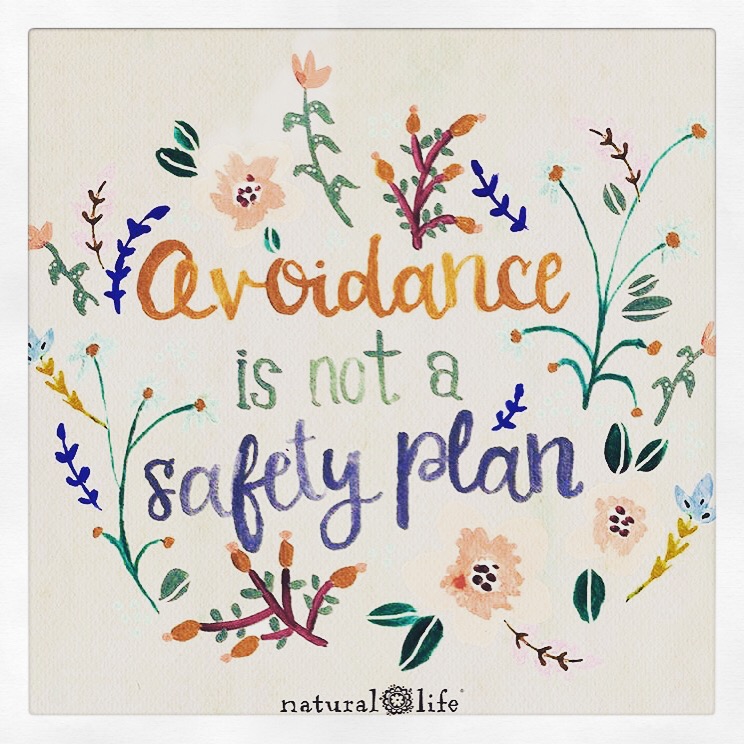
“Avoiding your triggers isn’t healing. Healing happens when you’re triggered and you’re able to move through the pain, the pattern, and the story and walk your way to a different ending.” – Vienna Pharaon
Such an important reminder. Just as important is remembering that healing well is a process vs. something we all are born knowing how to do. It requires the support of people who love us, who will walk alongside us come what may. It requires time and grace to keep going when it feels scary and too hard. Many times it requires a good therapist who can provide new tools for the daunting but necessary work ahead. We find the courage to add hope and health to seeds of pain and loss. The miracle comes, sometimes unexpectedly, when we start to see signs of new life across the fields of our life.
And new life never ceases to be a miracle.
We all experience times of dormancy. Times when it feels as if we’ve been buried so deep in the dark soil for too long. That growth has been permanently stunted and any hope of things changing is lost. But when we ask for what we need, and surround ourselves with people and resources willing to invest in our growth, we begin to see the truth regarding both our value and our potential.
Seeds can’t grow unless their needs are met, and neither can we. They need warmth and a good location, proper nutrients, and both sunshine and rain. But when they get what they need, it’s not long before they insist on realizing their full potential. Of becoming all that they were intended to be.


 hindsight
You must be logged in to post a comment.