Sometimes we are given glimpses into the character of our children, and when that happens I always want to sit back and give it the moment it deserves. My daughter and I were sitting poolside on a family vacation recently, enjoying a rare moment alone, catching one another up on life.
She shared how the same issue kept coming up in a relationship with a friend, despite several strategies on her part to find some kind of resolution. She was processing out loud, wondering if maybe she needed to take a break, not wanting to let resentment build to the point of saying something she couldn’t take back. The last thing she wanted to do was cause her friend pain or damage the relationship. I was mostly just listening, familiar with her dilemma, knowing there were no easy answers. After a moment of quiet reflection she said,
“I’ve already decided I’m going to do the right thing, I’m just not sure what that is yet.”
Our conversation was interrupted just then in the best of ways. My husband and son in law returned from a trip to Costco, and the grand babies started waking up from their naps, joining us outside. But later, as I was falling asleep that night, I thought again about what she had said and how it was such a beautiful reflection of the condition of her heart. She had already decided that regardless of the actions of her friend, her conflicted feelings about the situation, or the fact that there seemed to be no good present solution to an ongoing problem, she was going to do what was right.
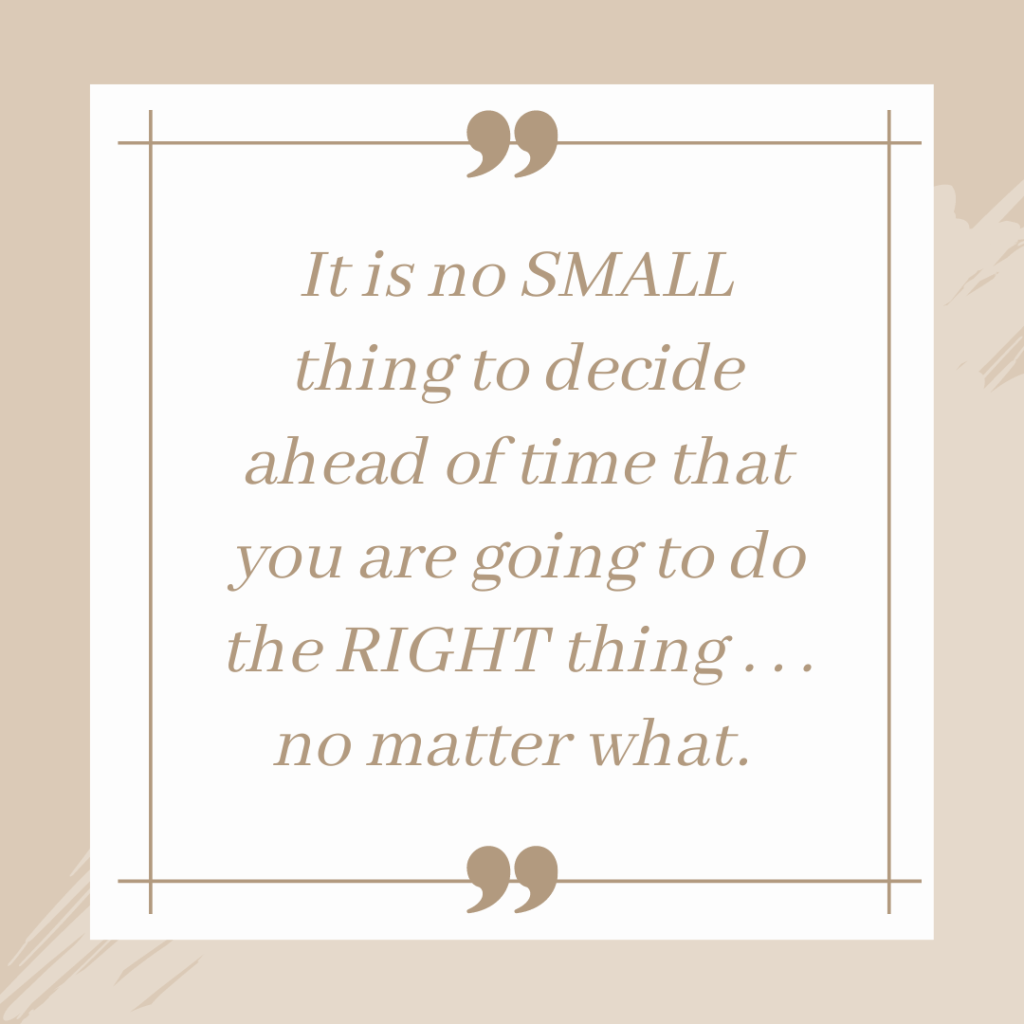
When we can take everything that we’ve been taught and decide ahead of time that, regardless of external forces in the form of people or circumstances, we are determined to do the right thing no matter what . . . we can know for sure that “mental and moral qualities distinctive to an individual” have been internalized.
Oxford Dictionary says that is the very definition of character. God calls it spiritual transformation.
It’s as good as it gets as a parent when a child grows up and takes everything you and others have taught them, sifts through it all, and decides on their own to keep what is good and true. Seeing them make a shift from simply having acquired knowledge of right and wrong, to incorporating those principles into their daily lives is the joy John talks about.
3 John 4:4 I have no greater joy than to hear that my children are walking in the truth.
Can you recall the moment or season of your life when you realized your faith became your own?
Or, if you’re not a person of faith, can you remember becoming consciously aware that you were no longer making good choices simply because your parents or other adults in authority were telling you to? If so, what age were you?
If you’re a parent, share a moment from your own life that you have witnessed your child be intentional about doing the right thing, especially when it was particularly hard to do.
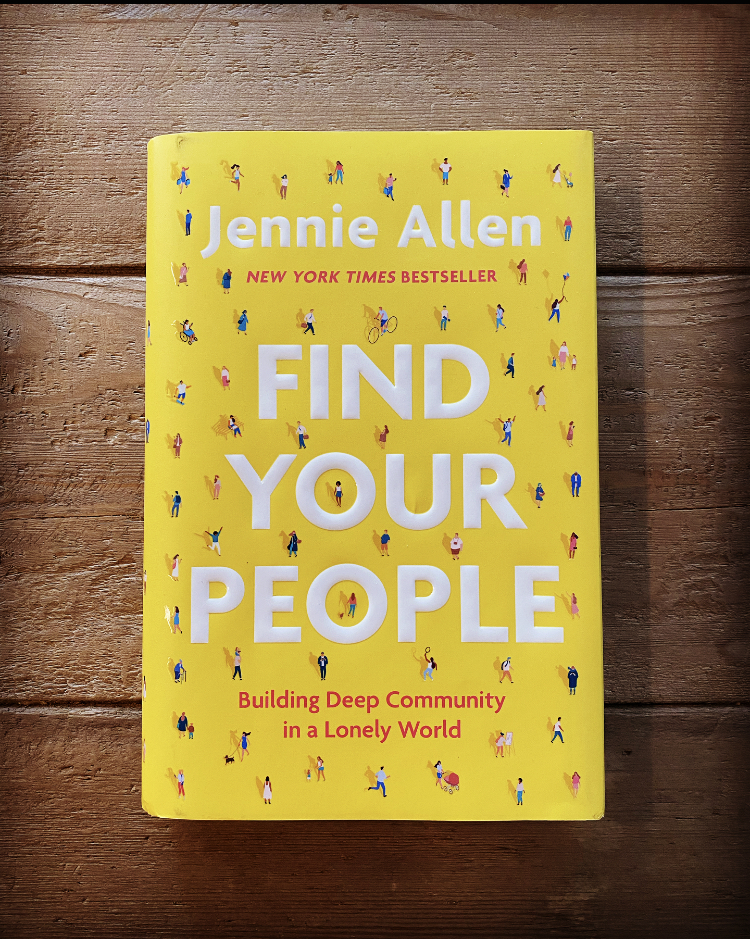
So many friends and family I talk with agree that finding and cultivating friends can feel hard, especially in a post-Covid world. But if you’re anything like me, you have an overriding sense that we were made for relationship. Community is something we actually need. I’ll follow-up with a review after making my way through the book.
Ben Franklin is famously quoted with saying that, ” . . . in this world, nothing is certain except death and taxes.”, but every mother will tell you that that’s simply not true. I would bet good money that a certain question is asked with incredible consistency, in every household.
“What’s for dinner?”
Our family is no exception. The person I can count on to pose the question faithfully in our home is my almost 25 year old daughter who is Autistic. Without fail, she starts her day (and mine!) with the same two questions.
“What are we doing today?” and “What’s for dinner?”
What we do on a daily basis changes from day to day, but dinner is a non-negotiable. It begs an answer. For me, the challenge is not so much in preparing the meal as it is deciding what to make. Maybe that’s true for you as well.
Fortunately, there are so many home cooks that are posting amazing content . They’re not just giving us dinner ideas, but also amazing content that shows us the preparation step by step. It’s hard not be inspired by those who truly love both the process and the final results.
One of my favorite home cooks to follow is Olivia Adriance. The recipes she shares are healthy and so easy to follow. She takes away all of my excuses that making things from scratch is too hard I’ve made several of her recipes and my family has loved each and every one. So, if you’re unsure what to make tonight, look Olivia up and start with the Chuck Roast Tacos. Simply amazing!
Think back to the first time you signed up on any given social media outlet. What kind of online community did you want to belong to? What kinds of “friends” were you hoping to find?
All of us share an innate desire to be “liked”. We all operate best as human beings when we are in healthy, supportive relationships. We all deserve to have people in our lives that truly enjoy us and choose to be with us. Friends that will move towards us, rather than away, when life gets hard. Those who will always show up for us, whether to celebrate our best days or sit with us in our pain.
Women have an amazing capacity to show up for one another.
Hindsight was created to be a safe space for all of us to share our stories. To share our celebrations and our struggles. To reflect on all the life that we have experienced to date and how we’ve grown as a result. To seek advice from a supportive community when we need it. To find solidarity in our roles as women.
The online community provides unlimited opportunities to get to know people from all around the world. Women who are mothers, daughters, sisters, and friends of all ages, races, cultures and countries.
Everyone has something to teach us.
One of the best ways I believe we can show up for one another is by sharing the wisdom we have acquired collectively through our life experiences. Things we know “now” that we wish we had known “before”. Before making important life decisions. Before the “aha” moments, the heartache, or the pain of poor choices.
Many of us seem to insist on learning the hard way. I know that’s been true for me too many times to count. But what I know for sure today, is that it doesn’t always have to be so hard.
One of my favorite quotes by Pastor John Maxwell states,
“It’s said that a wise person learns from his mistakes. A wiser one learns from others’ mistakes. But the wisest person of all learns from others’ successes.”
We have an incredible opportunity to learn from one another. To ask important questions. To provide perspectives and possibilities that may be hard to see on the “before” side of any decision. To share wisdom that has more often than not cost us a great deal to acquire. To give others hope that they can walk through hard things informed, rather than unaware, expecting the best outcome possible.
Wisdom is so valuable to God that the Bible states in Proverbs 4:7, “The beginning of wisdom is this: get wisdom. Though it cost you all you have, get understanding.”
“Though it cost you all you have.”
Wow. Anything that important to God should get our attention. Our choices and decisions are always going to cost us something. May we choose things that God would choose for us, and not settle for less than. Things to prosper us and not harm us. May we choose to tap into the example of those surrounding us who show us what it looks like daily to trust God, come what may.
God gave us one another to lean on and learn from. He knew that by doing so, we would spare ourselves so much potential pain. The bonus of seeking advice or asking for help comes when we choose to enter into authentic community with others. God created us for connection. When we enter into safe relationships, we never have to walk through hard things alone.
We need each other.
Merriam-Webster defines hindsight as, “The knowledge and understanding that you have about an event only “after” it has happened.”
Dictionary.com’s version states, “Recognition of the realities, possibilities, or requirements of a situation, event, decision etc., “after” its occurrence.”
Hindsight provides us with the gift of 20/20 vision . . . “after” we need it. It’s easy after the fact to clearly discern what was so difficult to see in the midst of our circumstances.
Why wait passively until “after” for knowledge and understanding? Why not recognize in advance “the realities, possibilities or requirements of a situation, event, or decision” we are faced with today by proactively preparing as best we can? We need to tap into one of the greatest resources available to us all to help us do just that. One another.
Merriam-Webster used hindsight in a sentence, and I loved the example so much that I used it as my blog’s tag line.
“In hindsight, it’s clear there were alternatives.”
Yes. Yes there were. It makes me laugh out loud every time. It’s what I say to my younger self on a regular basis when I recall so many questionable decisions I made growing up.
Looking back on your own life, what is one thing you wish your younger self would have known prior to making an important decision? If you are facing a difficult decision today, what questions or concerns do you have?
My 24 year old with special needs started a new life skills class today. Knowing she was excited but riddled with anxiety, I tried to keep her busy until it was time to go. We made a list together of things she wanted the staff to know about her.
“I am kind.” was her number one.
This was her first re-entry attempt into a social setting with peers in awhile. She graduated from public school just as COVID-19 was gearing up to rear it’s ugly head and bring life as we knew it to a screeching halt.
It’s probably safe to say that after so much time quarantined at home, it took most of us a minute to get used to being around anyone other than immediate family or close friends. That uncertainty can be exponentially multiplied when you have Autism. It means completely upending the current schedule that provides rigid security, bumpers if you will, that bring reassurance that life is consistent and therefore, safe. Implementing changes, even good change, can make one extremely resistant.
For those with sensory overload issues, every new situation they walk into leaves them in constant fight or flight mode, scanning for threats to their well being, perceived or real. Every one of their senses is heightened and they are filled with fear and anxiety, unsure of the unknown. It’s hard to send your kids off and entrust them with people you don’t know, no matter how great you’ve heard the program is or how well it’s been vetted. It’s especially hard when you know they are scared.
We arrived and at first she wouldn’t get out of the car. When she was finally willing to step out of the car, she announced several times over that she wasn’t going in. After several minutes of my unsuccessful persuasion, we were “rescued” by staff members. She decided after some cheerleading on their part that they were trustworthy enough to be around and off she went.
My daughter has taught me things her whole life. Today she reminded me that just because things may be good for you, it doesn’t mean they don’t feel scary at first. That we all may need time to adjust to new normals. That being brave happens one decision and one step at at time.
She also reminded me that no matter how old your kids are, you may still have to fight back the tears at drop off.
As we all press on through the myriad of everyday tasks, new things that stretch us but feel scary, or even when we are called on to do some unexpected, really hard things . . . may we remember that no season lasts forever. We can be excited and still cry. We can be scared and brave at the same time.
And maybe . . . most importantly . . . we can remember that everyone else is going through something, too.
So even when we’re not sure what to say or do next, we can always start with “kind”.
What was the last thing you did that you weren’t sure you could do? What did you tell yourself to push through?
School districts all across America are up and running, headed straight into a new school year that can only be described as “unprecedented”. Principals, teachers, and parents alike have braced themselves for yet another set of formidable challenges “gifted” by the year that is 2020.
Public school has had a consistent “look” to it since its inception in 1635. Classrooms and cafeterias, playgrounds and principal’s offices may differ in specifics, but all maintain the same general purposes. Brainfood and nourishment, play time and discipline are all things we have come to expect from a normal day at school.
Districts have been tasked with the seemingly impossible job of creating systems that will allow all students to receive instruction in a “one size fits no one” set of circumstances.
It is no small task to meet the instructional needs of a classroom full of children with different learning styles on a good day. Prior to COVID, teachers were already expected to do more with less. The “asks” of teachers have increased with each passing year, as have the challenges.
Multiple variations including remote learning, hybrid schedules, and in person school have been decided upon, each district burdened with choosing solutions they feel are sustainable. Regardless of the decisions made, criticism abounds. Frustrations are high. Teachers and parents alike have been on the receiving end of hate for their opinions and personal views on the best way to have students return to school this year.
We humans seek to control what we can, especially amidst times of uncertainty. A school district in the Midwest recently received public criticism after announcing that pajamas would be banned for remote learning, aligning with the same dress code rules that are in place for classes held in school buildings. It’s certainly understandable that they are seeking to maintain some semblance of structure. After all, structure is something we can count on. It provides a sense of security and clear expectations.
There are plenty of studies on both sides of the argument as to whether or not “dressing for success” actually helps to produce an environment conducive to increased performance. My intent is not to criticize a school district for wanting to provide expectations in the hope that a dress code will support student success.
It’s easy, however, to lose sight of what matters, especially when under duress. My guess is parents weren’t upset about a clothing rule. They were upset about an emphasis on something so trivial in light of all the sacrifices parents and students alike are being asked to make under less than ideal circumstances.
Growing up, many of us can remember being so excited to choose our “first day” outfit. Back to school shopping was something to look forward to. It made the impending return to school after a summer of freedom, a little more palatable. Never could we have imagined that one day we would be incorporating masks into our children’s wardrobes.
I held the position of Family Liaison for almost a decade in one of the wealthier public school districts in the nation. Family Liaisons act as a school to home connection, providing all families in the district with a home base of sorts within each school building. It is there that parents can find support and information and be made aware of needed resources in both the district and the surrounding community.
The role was implemented under the premise that there is a direct correlation between kids having their basic needs met and their ability to succeed academically. We, as a district, wanted to give students every opportunity we could control to facilitate optimum growth.
All families were welcome, but centers were most frequented by the most vulnerable. Basic needs were provided to students and their families via program support from the city, local churches, non-profits and businesses. The list included things such as counseling, before and after school care, tutoring, and opportunities to participate in sports programs with a mentoring component. We also connected families in need to agencies that could provide food, rent, utilities, and legal support.
Some of my favorite programs were the ones through which students could access clothing. A few agencies provided vouchers to students, specifically allocated for new school clothes. Students, accompanied by parents or guardians, were able to shop at local stores and choose any and as many items as their designated amount would allow. The shopping events provided clothing, but also an experience, allowing those selected to be just like their peers. It also provided me with a deeper understanding of the economic disparity in our district.
I’m not sure what the demographics look like in the Midwest region that came under fire for the pajama ruling. What I do know for sure, however, is that for many of the students I served, wearing pajamas to online class would be a non-issue. Not because of a rule or parents insisting they dress appropriately.
They simply don’t own any.
The reality for most families that are struggling to pay rent and put food on the table is the fact that pajamas are non-essential. The clothes their kids wore for school may very well be the same ones they slept in last night. They don’t have the “luxury” of worrying about whether or not their kids are breaking dress code rules because they showed up for class in their favorite pj’s. What they, like most parents, do worry about is the emotional health of their children. They worry about them fitting in, knowing anything that makes them different can also make them a target for bullying.
Students may be living in poverty and even experiencing homelessness, but they are no different than any other children in every other way. They want nothing more than to be like their peers. They know that having the right clothing is an equalizer of sorts, albeit it a shallow one. One unexpected benefit to the “no pajamas in class” rule is the relief kids that don’t own any must have experienced.
Our kids are carrying a lot. Most of us are very aware of that and do our best to protect them as much as possible from “adult” issues. That’s not to say I think for one second that kids don’t know what’s going on. They may not be able to articulate well verbally, but there is no mistaking the full impact that multiple hardships hold over their current reality.
2020 has provided us with a world-wide time out. These are uncertain times for those of us alive at this precise moment in history, with this particular set of challenges. But of this we can be certain . . . we are far from the first, nor will we be the last, to experience loss and hardship. What will history, and more importantly our children, have to say about how we handled ourselves? What have we learned?
The truest way to measure if we have internalized anything at all from the adversity we have faced, both personally and as a nation, will be in what we choose to prioritize going forward. It will show up in everything we do, from how we treat one another to the things we choose to focus on.
We would serve ourselves and others well to be mindful that not all hardship is created equal. It’s not to say that what we are going through isn’t difficult, but sometimes learning about the stories of others provides us with some much needed perspective.
So, let’s not worry so much about pajamas. Let’s not make rules that students can’t wear pj’s to online class, especially when mom, dad and all of corporate America have admitted to working in theirs since March. Let’s instead model authenticity and the very things that we want our kids to emulate.
Teaching students to value all others and not view anyone as less will serve them far more than learning to add and subtract numbers. Let’s not focus our attention on outside appearances and instead, work on cultivating character from the inside out. Let’s make sure that while we are sending them off to learn in school, we ourselves get the lessons that life is trying to teach us.
Regardless of the year, the culture, or the current circumstances kids are always looking for the adult in the room. They want to know who can keep them safe. It is our responsibility, as adults, to do just that. We cannot always shield them from hard things no matter how desperately we would like to. But the worst possible thing we can do to our children is strip them of hope.
We need to remember they are always listening, watching and internalizing our reactions and responses to what is happening in the world around us. They learn to “read the room” far sooner than they should have to. We must not conduct ourselves in ways that leave them despairing and full of fear.
It’s not about having all of the answers. It’s about making sure they know they are not alone. It’s reassuring them that we will never give up pursuing solutions. It’s about reminding them, and ourselves, that sometimes the most important thing we can do in life is just keep showing up.
“With everything going on I immediately just thought, ‘Wow, what a powerful photo.’. Then I realized it was me. The words are still hard to find, but I wanted to share the one thing that did go through my mind in this moment. As a child, I grew up with a single white father and who was originally from Chicago. He taught us from a young age that things were going to be different for us just because of the color of our skin. One of the things he used to remind us constantly was that ‘no matter the threat, always look them in the eye so they have to acknowledge you’re human’. My father passed 16 years ago this month. In this moment, those are the words that went through my head. When I lifted up my glasses, he saw me. I saw him. He was acting out fear, I know that. I hold no malice in my heart for this man. I hope this moment will soften him. I hope he will be changed. But even if he isn’t, I am.” – Samantha Francine
When I look back on this moment in history, I know this will be one of the images I will always remember. It’s not necessarily because of the photo, which in and of itself is so powerful. It tells a story without using a single word. The angry white man with fists clenched, towering over the black woman; seeking to “communicate” via intimidation, using both language and body language.
Listening to the video (not shown here) filled in the blanks. The man was screaming and swearing in the woman’s face. The woman, while saying nothing in return, raised her sunglasses to look at him in the eye. He was going to say what he was going to say, but he was going to see her while he did so.
She made the choice to look up at him, even as he was looking down at her. He walked in circles, spewing hateful words, unraveling in a failed attempt to control her or the others in the crowd. He couldn’t even control himself.
She, on the other hand, chose a measured response. Her silence was her choice, not his. What her silence gifted him in that moment was the opposite of what he deserved. In strength, she also chose compassion, understanding, and forgiveness. She chose to see his pain even while in her own. This was not a natural response.
“The response that has the potential to reverse the natural course of things isn’t natural. The catalytic response is the least intuitive response. The response that makes the most difference in a positive direction is the response that we are least likely to choose.” – A.S.
An angry response would have been more than justifiable by any human’s standards. But she chose instead to offer better than what comes naturally to us all. She responded to him the way God responds to us, with unmerited mercy and grace. Not because of who he is, but because of who she is. His hate cannot diminish her true worth or identity and she clearly knows that. Hopefully, he will come to understand that.
Her father’s hope was that we would always see one another’s humanity. My hope is that we all come to see ourselves and other’s how the Father sees us. All created in His image, every single one of us. “There may come a time when it will be possible for you to humiliate your worst enemy or even to defeat him, but in order to love the enemy you must not do it… The Greek language has another word [for love]. It calls it agape.
Agape is more than romantic love. Agape is more than friendship. Agape is understanding, redemptive goodwill for all men. Agape is an overflowing love, a spontaneous love, which seeks nothing in return. And theologians would say that it is the love of God operating in the human heart.
When you rise to love on this level you love all men, not because you like them, not because their ways appeal to you, not because they are worthful to you, but you love all men because God loves them. And you rise to the noble heights of loving the person who does the evil deed while hating the deed that the person does. And I think this is what Jesus means when he says, ‘Love your enemies.’ – MLK



 hindsight
You must be logged in to post a comment.